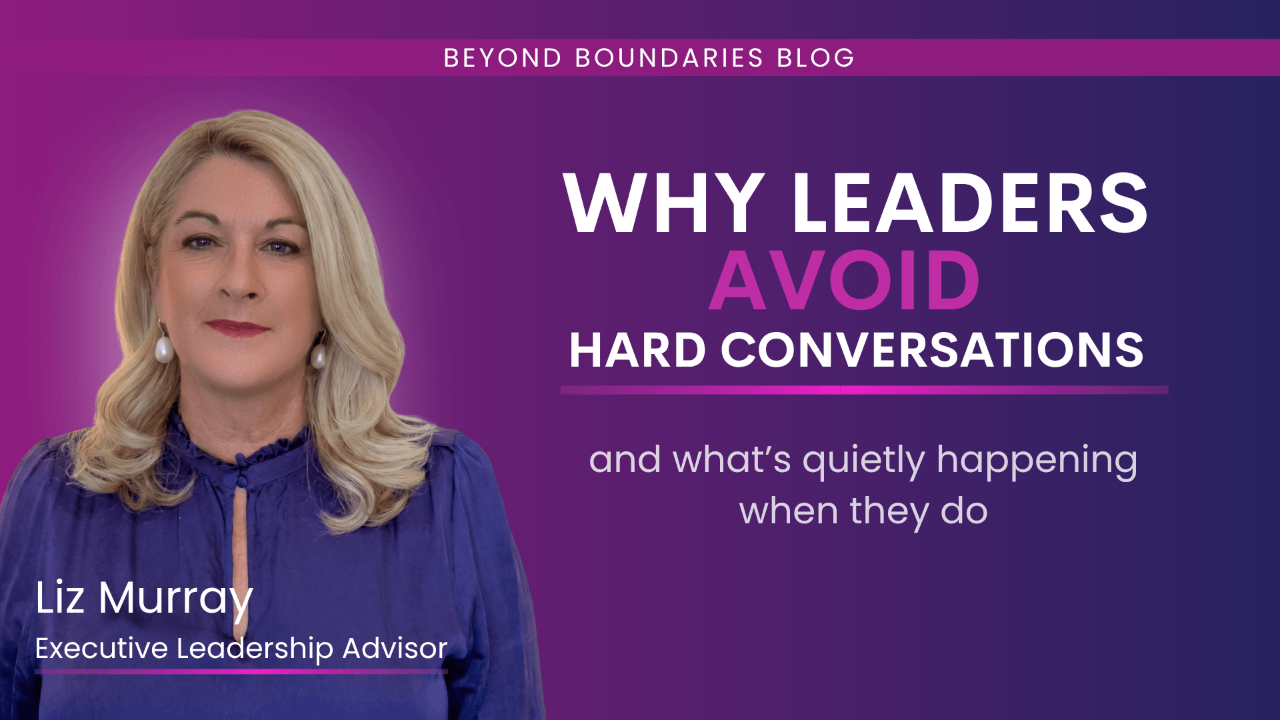
Why Leaders Avoid Hard Conversations And what's quietly happening when they do
May 12, 2026Most leaders I work with are not conflict-averse.
They're clarity-averse.
They don't avoid people. They avoid the moment. The specific, direct, this-is-what-I-need-from-you moment that feels too exposing, too risky, or simply too hard to get right.
And so instead of saying the thing clearly, they say something close to it.
Close enough to feel like they've addressed it.
Far enough away that nothing actually changes.
This is where standards erode. This is where culture quietly shifts. And this is where leadership starts to cost more than it should.
It Doesn't Always Look Like Avoidance
Here's what makes this pattern so difficult to spot.
It doesn't always look like silence.
Sometimes it looks like a leader who is doing everything right on paper. Regular check-ins. Open door. Always available. Genuinely invested in their people.
I worked with a leader like this recently.
Approachable. Consistent. Present.
But their team was stuck. The same performance issues kept surfacing month after month and nothing was shifting. Frustration was building quietly on both sides.
When I started working with this leader, I asked them one question.
"When you give feedback, what do you actually say?"
They walked me through a recent example. A team member whose work had been consistently below standard for weeks. The leader had raised it. They had sat down. They had said something like:
"I just want you to know I think there's room for you to grow in this area and I'd love to see you step up a bit more."
That was it.
No specific example named. No clear standard articulated. No indication of what needed to change, or by when.
The team member left that conversation nodding.
And had absolutely no idea what they were supposed to do differently.
Avoidance Wearing the Costume of Feedback
This is the pattern most leaders don't see in themselves.
They conflate having the conversation with having the hard conversation.
They show up. They say words. They tick the internal box that says "I've addressed it."
But the real content, the specific behaviour, the direct expectation, the honest consequence, stays safely inside their head where it can't cause discomfort.
This is not a communication failure.
It is an avoidance pattern. And it is far more common than most leaders want to admit.
The team member in this situation wasn't underperforming out of attitude or lack of effort. They were operating without the information they needed to perform differently. They sensed something was off. They didn't know what to do about it.
That gap sits entirely with the leader.
When Silence Does the Same Damage
There's another version of this pattern that looks completely different on the surface.
A leader who doesn't show up to the conversation at all.
I know of a leader who had been meaning to address something with a team member for six weeks.
Six weeks.
They knew the conversation needed to happen. They had mentally rehearsed it multiple times. They had told themselves they'd do it after the project wrapped up. After the busy period settled. After things calmed down.
In those six weeks, the behaviour had spread. Two other team members had noticed. The standard had quietly shifted across the whole team, not because anyone had decided it should, but because nothing had been said.
The leader had convinced themselves the moment had passed.
It hadn't.
It had just got harder.
The Same Pattern, Two Different Faces
Two leaders. Two situations. The same thing underneath.
Avoidance doesn't always look like silence. Sometimes it looks like a conversation that happened but never really went anywhere. Sometimes it looks like feedback that was given but didn't land because it was never actually clear.
Both are avoidance. Both carry a cost.
And here is what that cost looks like inside a team.
Standards shift without anyone naming them. People sense something is unsaid even when they can't articulate what it is. Trust erodes quietly. Not in one dramatic moment, but in the accumulation of conversations that almost happened.
Your team is not confused about your values.
They are confused about your standards.
And that confusion sits with the leader.
What Clarity Actually Requires
This is not about becoming harsher. It's not about delivering feedback like a verdict or turning every performance conversation into a confrontation.
It's about becoming specific.
When that first leader shifted from "I'd love to see you step up a bit more" to "In the last three project reviews, the reports have been submitted late and without the analysis section complete. That's the standard I need met every time. What's getting in the way?" everything changed.
Same leader. Same relationship. Same care for the person sitting across from them.
Completely different conversation.
The team member finally understood what was required.
And they delivered it.
Clarity is not cruelty. Specificity is not an attack. When you name the behaviour, the standard, and the expectation directly, you give the other person something real to work with. You respect them enough to tell them the truth.
Vague feedback says: I don't trust you to handle the real conversation.
Clear feedback says: I believe you can do better and here is exactly what that looks like.
Reflection
Before you move on, sit with these:
Think of a piece of feedback you've given recently. If that person had to write down the three specific things they needed to change, could they?
Is there someone on your team right now who is underperforming but might genuinely not know what good looks like in your eyes?
When you give feedback, are you saying what is true, or what is comfortable?
And the bigger one: where in your leadership are you showing up to the conversation but not actually having it?
Watch or Listen
Embed your YouTube video here
Embed your podcast episode here
Work With Me
If this is resonating, it is worth asking yourself whether vagueness has become a habit in your leadership.
Not because you don't care. Because you do.
But care without clarity doesn't move people forward.
Inside Be Exceptional, this is one of the core patterns we work through together. How to lead with clarity, hold the standard, and have the conversations that actually shift things.
Because once you stop softening the message, your team finally gets it.
Call to Action
Want more? Watch the full video or listen to the podcast episode.
Check out my On Line Course!
Take your Leadership skills to a whole new level, whether you are a seasoned professional or new to leadership.
Be Exceptional
The on Line Course that shares the secrets to how to show up as a Leader without the burnout and overwhelm.