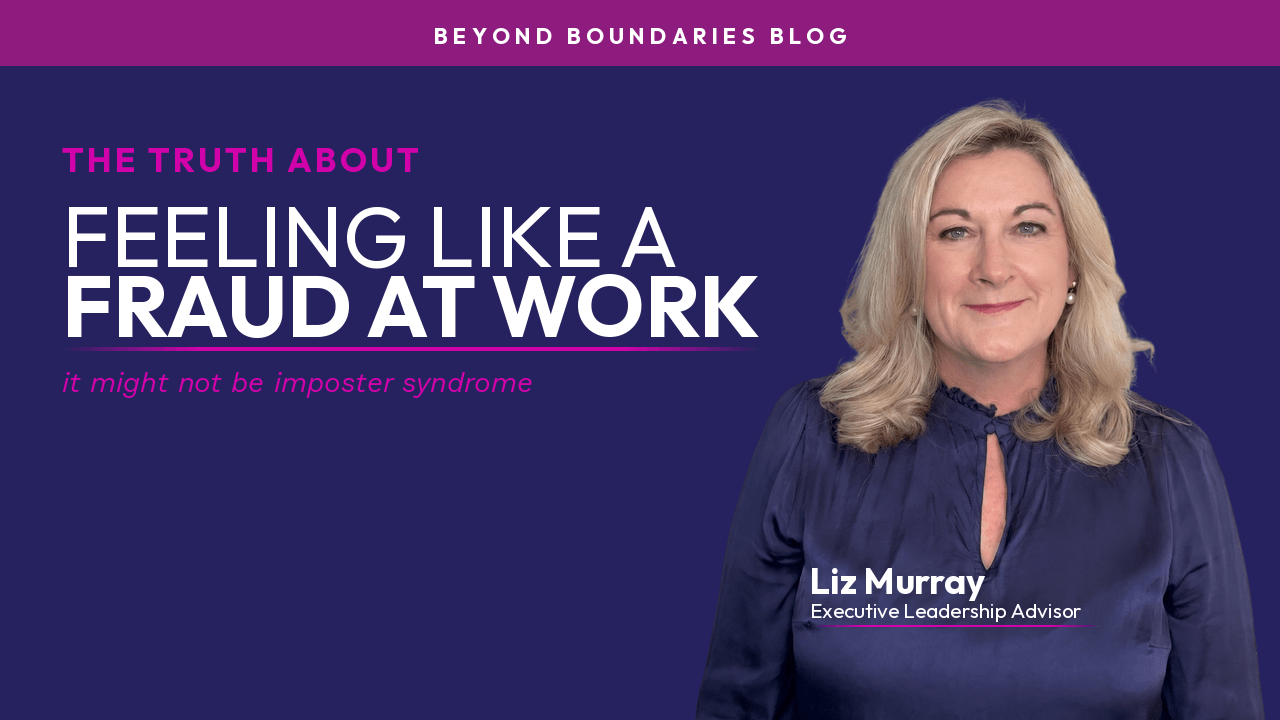
Why You Feel Like a Fraud at Work (It Might Not Be Imposter Syndrome)
Jul 01, 2026You're good at your job. The results are there. People look to you. And yet there's a quiet voice that says you're getting away with something, and one day everyone will find out.
Most leaders are told that's imposter syndrome. That you just need more confidence, more evidence, more time in the role, and the feeling will pass.
But for a lot of capable leaders, it doesn't pass. The promotion comes, the wins stack up, and the fraud feeling is still there. If that's you, it might not be imposter syndrome at all. It might be that you're performing.
I work with leaders and high performers on exactly this, and the shift from performing to presence is one of the most freeing changes a leader can make. Let me explain what's actually going on.
Why do I feel like a fraud at work even when I'm good at my job?
Often it's because you're performing a version of leadership instead of leading as yourself.
Somewhere along the way most of us absorbed the idea that presence is something you put on. Stand tall. Speak with conviction. Hold the room. Look the part. So we manage all of it. The posture, the tone, the face we make when someone challenges us in a meeting.
And it works, on the surface. People think we've got it together.
But here's the catch. If presence is something you're performing, part of you knows it isn't fully real. You're managing how you come across and hoping nobody looks too closely. That gap, between the version you're projecting and what you feel underneath, is what reads as fraud.
It isn't a competence problem. It's a performance problem. And no amount of evidence about how good you are will close a gap that's being created by the performing itself.
Is it imposter syndrome or something else?
Imposter syndrome is usually described as a confidence gap, a fear that you're not as capable as people think. The standard fix is to gather proof of your competence until the fear quiets down.
The problem is that the proof rarely works for long. You can have a wall of evidence and still feel like a fraud the next time you walk into a room.
That's the tell that something else is going on. If competence were the issue, competence would fix it. When it doesn't, the real issue is often that you're leading from performance rather than from who you actually are. You're not afraid you're not good enough. You're tired from holding up a version of yourself all day.
The fix isn't more confidence. It's less performing.

What is executive presence really?
Executive presence isn't something you project outward. It's something people feel from you.
This is the part most advice gets backwards. We're taught presence is a set of behaviours to perform: the way you stand, the way you speak, the way you command a room. But the leader who's performing authority and the leader who actually has it can say the exact same words, and the room responds completely differently.
People clock the difference in seconds, even if they can't name it. You can't fake what people feel.
Real presence is quieter than the performed kind. It's calm. It doesn't need to prove itself. People trust it without being able to explain why. And it can't be bolted on from the outside, because it comes from the inside, from who you're being rather than what you're doing.
That's why the leaders with the most presence often look like they're doing the least. They're not managing a performance. There's nothing to manage.
Why is performing presence so exhausting?
Because you're holding up a front all day, and a front takes constant energy to maintain.
Think about the leaders you know who come home from a big meeting completely depleted. Not because the work was hard, but because something they're apparently good at took everything out of them. That depletion is the cost of performing. You're monitoring how you're coming across the entire time, ready to manage the moment something threatens the image.
When your authority comes from who you are instead, there's nothing to defend. Someone can challenge you and you stay steady, because their reaction isn't a threat to your sense of who you are. That steadiness is the thing people actually trust. And it costs you far less, because you're not performing anything. You're just there.
The exhaustion isn't a sign you're not cut out for leadership. It's a sign you're leading from the wrong place.
How do I stop performing and lead with real presence?
You start by changing the question you're asking yourself.
Most leaders walk into a room asking, often without realising it, how do I look more authoritative. That question keeps you managing the surface. It keeps you performing. And it's the trap, because the harder you work the surface, the more depleted you get and the less real it feels.
The shift is to ask a different question instead. Not how do I appear, but who am I being when I walk into the room.
That one change moves you off the surface and back to yourself. It's not about adding more. It's about letting the performance go and trusting that who you are is enough to lead with. The calm, the steadiness, the presence people trust, none of it comes from doing more. It comes from coming back to yourself.
Here's a question worth sitting with. If you stopped managing how you come across, even for one meeting, who would you be in that room?
The truth about leadership presence
Authority isn't about how you look. It's about who you're being.
If you've spent years managing the optics and wondering why something you're good at takes so much out of you, the answer might not be that you need more confidence. It might be that you're carrying the weight of a performance you never needed to put on.
The leaders who hold a room without trying aren't performing harder than you. They're performing less. They've stopped asking how do I look, and started leading as themselves.
That's the work. And it's lighter than what you're doing now.
See where your own authority is drifting
If any of this landed, there's a simple way to see where you stand.
The Leadership Mirror is a free, honest, three-minute look at how you lead. It shows you where your authority is strong and where it might be drifting into performance, so you know exactly where to focus rather than working on everything at once.
It's free, it takes a few minutes, and it'll show you what most leaders never stop long enough to see.
Check out my On Line Course!
Take your Leadership skills to a whole new level, whether you are a seasoned professional or new to leadership.
Be Exceptional
The on Line Course that shares the secrets to how to show up as a Leader without the burnout and overwhelm.