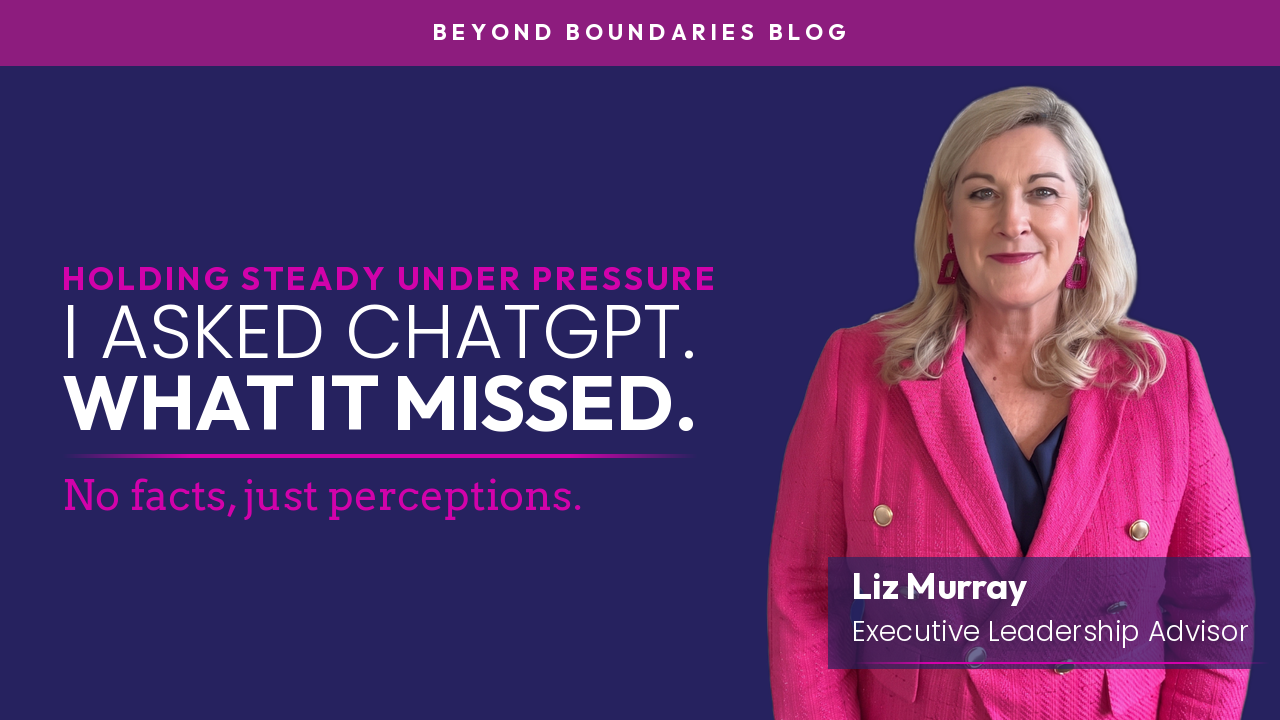
Why You Feel Exhausted When You Look Fine
Jul 27, 2026By Liz Murray | Edge of Possibilities
There is a type of leader I recognise immediately.
They move through the day competently. Meetings run. Decisions get made. The team sees someone steady and capable. To the people around them, everything looks fine.
Underneath? It's different. There's a version of them running very fast, just out of sight, working constantly to hold everything together, anticipate every problem, absorb every difficult moment before it lands on anyone else.
The swan image is almost too accurate. Serene above the water. Feet going hard underneath.
If this is you, I want to offer you something that might feel unusual: this is not a you problem. What I see in leaders like you, time and again, is a specific and very fixable pattern. And the exhaustion you're feeling is not just burnout. It's the cost of performing leadership instead of living it.
Why looking fine costs more than it should
Leadership asks a lot. But there's a particular kind of exhaustion that doesn't come from the volume of work. It comes from the performance on top of the work.
When you're performing calm instead of feeling it. Performing confidence instead of drawing on it. Performing capability instead of actually leading from it — your nervous system knows the difference, even when no one else does.
Eighty per cent of Australian workers reported burnout in recent research. What that number doesn't capture is how many of those people looked absolutely fine from the outside. How many were managing up, managing sideways, managing their team's feelings and their own fear, and somehow still turning up to every meeting looking like they had it handled.
The performance itself is what's draining you. And until that pattern is named, no amount of better time management, delegation frameworks, or mindset content will touch it.
What I watched happen with Merrick
Merrick came to me because he didn't know what else to do.
He was stretched thin. His managers were pushing back about workload and telling him they weren't happy in the workplace. His instinct, because he's a genuinely caring and capable person, was to absorb more. Take some pressure off them. Pick up the slack. That's what good leaders do, right?
Except it wasn't working. The more he carried, the more they struggled. The more pressure they put on him about their workload, the more overwhelmed he became. He wasn't sleeping well. He was becoming reactive in moments that used to feel manageable. The output of the team was dropping.
And when we sat with it properly, what became clear was this: he had created a culture of fear without ever intending to.
Not through harshness. Through the opposite. By never holding firm expectations about what was required, by stretching himself to cover the gaps whenever the pressure came, he'd built a team that didn't know what was truly expected of them. Teams without clear expectations don't flourish. They manage up, they manage sideways, and they keep pushing the pressure back to the leader who's already carrying too much.
This is one of the most common patterns I see. A leader who cares, stretched to breaking point, wondering why the harder they work the less the team functions.
The shift that changed everything
Coaching with Merrick wasn't about giving him more tools. It was about helping him see the pattern clearly, and making a decision about the kind of leader he wanted to be.
What changed wasn't his effort. It was his focus.
He got clear about expectations and started holding them consistently — not just in the difficult conversations he'd been avoiding, but as the daily standard his team could rely on. He moved from reacting and rescuing to checking in, clarifying, and building his team's own capability. He started asking more questions and carrying fewer answers.
The whole shape of his day flipped. He stopped being the fire everyone brought their sparks to. He became the person helping his team learn to handle fire themselves.
He's no longer reactive. He no longer needs to be, because expectations are clear and people are working within them. He's sleeping. He's present. And the team? They're performing.
That's what I mean when I say the exhaustion isn't about workload. Merrick's workload didn't shrink dramatically. What shifted was the weight he was carrying that was never his to carry.
The pattern underneath all of it
What Merrick experienced has a name in the work I do. It sits at the intersection of two things that quietly erode a leader's authority over time.
The first is unclear standards. When expectations aren't held, people fill the gap with their own interpretation, and that interpretation is usually shaped by what they can get away with, not what's actually required. The leader feels this as pressure. The team feels it as confusion.
The second is carrying what belongs to others. Every time a leader absorbs a team member's discomfort, picks up their dropped ball, or rescues them from the natural consequence of unclear performance, they reinforce a dynamic that drains everyone. The leader carries more. The team grows less capable. The gap widens.
Neither of these is a character flaw. They're patterns. And patterns can be identified, named, and changed.
You don't need a title for this to apply to you
I want to say something that often gets lost in leadership conversations.
You don't need a formal leadership role, a team of twenty, or an executive title for any of this to be relevant to your life.
If you influence other people, even a few, even one, you're already leading. If you're self-employed, running your own business, or working as a consultant or professional in service of clients, you lead every day. Every conversation where you hold your ground or let it slip, every expectation you set clearly or leave vague, every moment you show up as yourself or as a performance of who you think you should be, that's leadership.
And if something feels off in how you're showing up, whether that's to your team, your clients, your colleagues, or yourself, it's worth knowing where the drift is happening.
Only 28 per cent of Australian organisations invest in developing their leaders. Which means most people carrying real responsibility are finding their way without genuine support. That gap is exactly where patterns like Merrick's take hold, quietly, gradually, until the exhaustion becomes impossible to ignore.
The first honest look
The Leadership Mirror is a free five-minute self-assessment that measures your leadership across four areas: how clearly you make decisions, how you hold up under real pressure, whether the standards you set are the ones you actually enforce, and whether you're carrying what's yours or absorbing what belongs to others.
Your result places you in one of four bands and gives you specific, direct feedback. Not a personality type. Not generic advice. A clear picture of where your authority is real and where it might be quietly slipping.
It's the first step I wish someone had made available to me years ago. I built it because I kept looking for something like it and couldn't find it.
If you're reading this and recognising the swan, I'd love for you to take it.
Take The Leadership Mirror here — free, five minutes.
And if you take it and want to talk through what it shows you, an Authority Reset Debrief is available. Thirty minutes, $97 AUD, just the two of us looking at your result and what it means for how you lead.
Because the gap between who you are and who you're performing being is closable. Merrick closed it. I've watched many leaders close it. And what's on the other side isn't just less exhaustion. It's leading in a way that fits who you actually are.
Liz Murray is an Executive Leadership Coach and founder of Edge of Possibilities. She works with senior leaders and professionals across Australia to close the gap between the leader they're performing and the leader they actually are. Find out where your authority stands with The Leadership Mirror — a free, five-minute self-assessment at edgeofpossibilities.com.au
Check out my On Line Course!
Take your Leadership skills to a whole new level, whether you are a seasoned professional or new to leadership.
Be Exceptional
The on Line Course that shares the secrets to how to show up as a Leader without the burnout and overwhelm.